
THE OEM DIFFERENCE
The OEM Difference: What a Standards-Based Repair Actually Means
Every vehicle manufacturer publishes repair procedures for its own cars — which panels can be sectioned and where, which welds are permitted, what has to be measured, what has to be calibrated, and what has to be inspected after a collision. These are not suggestions. They are the instructions written by the people who engineered the car to protect the people inside it. Following them is the entire job.
The uncomfortable part is that a repair done to those standards and a repair that merely looks right can be impossible to tell apart in a parking lot. Both cars are shiny. Both doors close. The difference only shows up in a second collision, in a safety system that does not react the way it was designed to, or years later when a buyer pulls the history. At Excite Collision Repair we look up the procedure for your specific vehicle, follow it, and document what we did — so the difference is on paper instead of on trust.
Not Drivable? We’ll Come and Get It.
Free local towing is available to qualified customers based on location — just ask when you open your case. Rental vehicles are available as well, so you are not left arranging one on your own while we handle the repair.
Start Your RepairWhat You Can’t See in a Finished Repair
A repaired car looks like a repaired car. Paint hides everything underneath it. These are the decisions made before the paint went on — the ones you will never be able to inspect yourself:
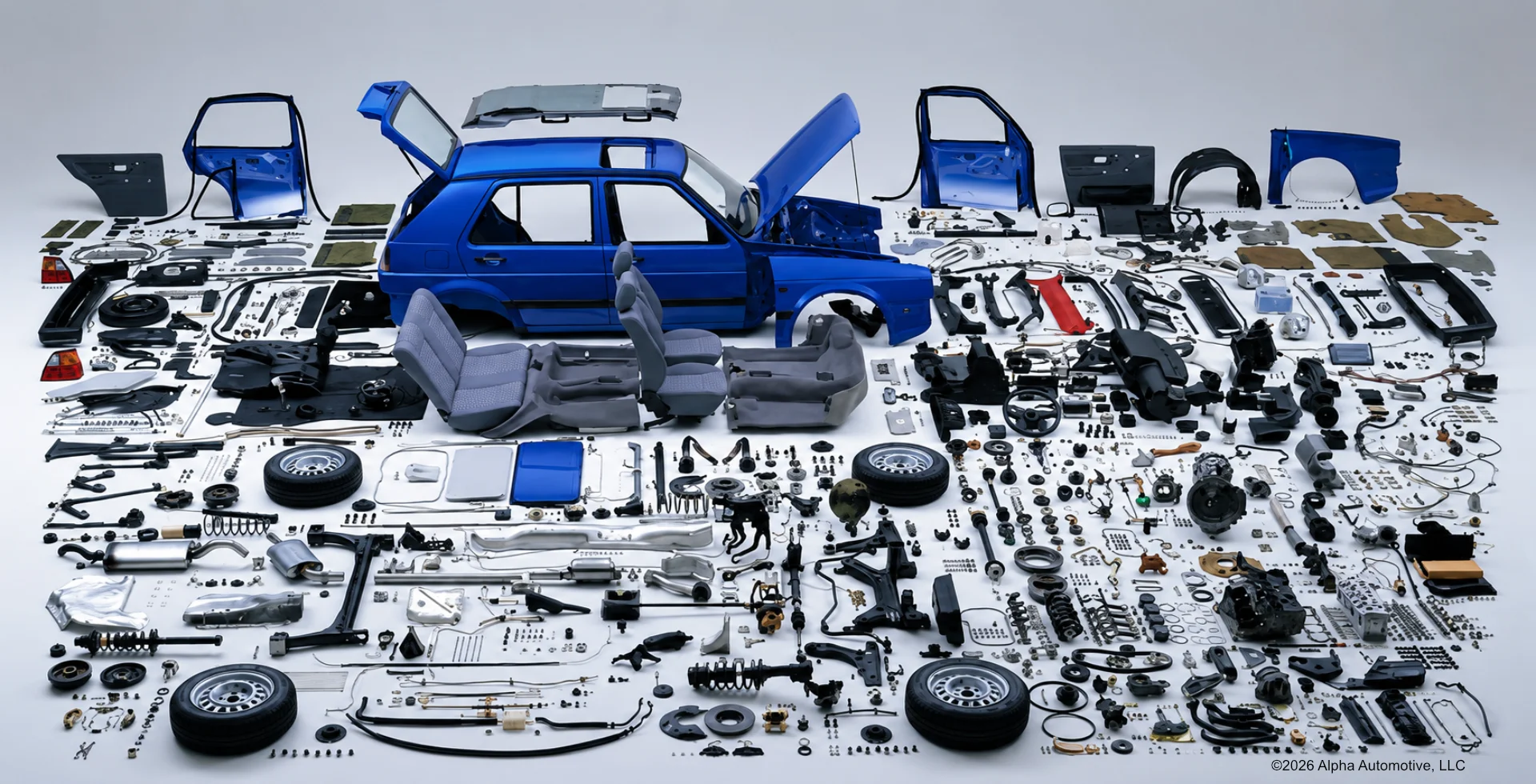
One vehicle, taken completely apart. Almost none of it is visible once the car goes back together — which is why the procedure matters more than the finish. Click to view full size.
- Whether the manufacturer’s procedure for your specific year, model and trim was looked up at all — or whether the shop went from memory
- Whether a panel was sectioned at a permitted location, or wherever was convenient
- Whether the structure was measured before and after, or eyeballed once it looked straight
- Whether required ADAS calibrations were performed — there is often no warning light to tell you they were skipped
- Whether post-collision safety inspections the automaker requires — seat belts, airbag sensors, steering column — were actually carried out
- Whether corrosion protection was restored at every weld and heat zone, or left to start rusting quietly
- Whether any of it was written down, so you can prove what was done when you sell the car
How We Work to OEM Standards
- We research the procedure before we write the estimate. Repair information changes by model year, trim and even engine type. We look yours up rather than assume, and the required operations go onto the estimate from the start.
- OEM scan tools in-house. Factory tools read the build data your vehicle actually shipped with. Most shops rely on aftermarket tools alone; we do not.
- Measured to diagnose, measured again to verify. Structural work starts with a measurement and ends with one. Verifying the finished structure is one of the most commonly skipped steps in this industry — see frame and structural repair.
- Calibration is part of the repair, not an afterthought. If the manufacturer requires a camera or radar recalibrated after an operation, it is written in, performed, and verified before the vehicle leaves.
- I-CAR, ASE, PPG and 3M certified technicians and estimators. Certification on the estimating side matters as much as on the floor — work that never makes it onto the estimate never gets done.
- We advocate with your insurer, and we document the outcome. We make the case for the operations your vehicle requires, including supplements, and you get a record of the finished repair.
Questions Worth Asking Any Body Shop
These apply to us and to every other shop in town. Ask them before you leave your car anywhere — and if you want to talk any of it through, call us at (614) 930-6103.
What does “OEM repair procedures” actually mean?
OEM stands for Original Equipment Manufacturer — the company that built your vehicle. Manufacturers publish detailed, vehicle-specific instructions for repairing collision damage: what can be repaired versus replaced, where a panel may be sectioned, which welds and adhesives are approved, what must be measured, and what must be calibrated or inspected afterward. A standards-based repair means those documents were pulled up for your exact vehicle and followed.
Why does it matter if the car looks fine when it is done?
Because the parts of your vehicle that protect you in a crash are not the parts you can see. Crumple zones, structural adhesives, high-strength steel sections and sensor mounts all sit under paint and trim. A repair can look flawless and still leave the vehicle unable to manage crash energy the way it was engineered to. Your family’s safety is not a line item, and a good-looking repair is not the same thing as a correct one.
Do I have to use the shop my insurance company recommends?
No. Your insurer may suggest a shop, and there can be good reasons to consider one — but the choice of who repairs your vehicle belongs to you. You are entitled to have your car repaired where you want it repaired. If you would like us to handle the claim conversation on your behalf, we do that routinely.
What is the difference between OEM, aftermarket and recycled parts?
OEM parts are made by or for your vehicle’s manufacturer to the original specification. Aftermarket parts are made by a third party to fit. Recycled parts are original parts taken from another vehicle. All three have legitimate uses, and your policy may influence which are used — but on structural and safety-related components the choice matters more, because fit and material behaviour affect how the vehicle performs in a crash. We will tell you what is going on your car and why.
Why did my estimate change partway through the repair?
That is a supplement, and it is normal. The first estimate is written from what can be seen while the vehicle is still assembled. Once panels come off, damage that was hidden becomes visible — and the manufacturer may require operations nobody could have known about beforehand. A supplement documents that additional work and goes to your insurer for approval. It is not a sign something went wrong; a shop that never writes supplements is often a shop that never looks.
What documentation should I get when the repair is finished?
Ask for the final repair order showing the operations performed, the parts used and their type, any structural measurements taken, and records of any calibrations or post-collision safety inspections. Keep it. It protects you if a question comes up later, and it makes a much easier conversation with a future buyer than an undocumented structural repair.
What should I ask a body shop before I leave my car?
Four questions cover most of it. Will you look up the manufacturer’s repair procedures for my specific vehicle? Will you measure the structure before and after? Which calibrations does my vehicle require, and will you perform them here? And will I get documentation of all of it? A shop that answers those clearly is telling you how it works. One that waves them off is telling you something too.
Does repairing to OEM standards cost more?
Sometimes the estimate is higher, because it includes operations the manufacturer requires that a thinner estimate leaves off — research time, measuring, calibrations, required inspections. In most cases those are covered as part of properly restoring the vehicle, and making that case to your carrier is our job, not yours. We also have up-front pricing, and we can help you save on your deductible for qualified insurance work.
How do I get started?
Call us, or request an appointment online and send photos of the damage from your phone — that is often enough to get the conversation going before the vehicle is even here. If it is not drivable, do not worry about getting it to us; call and we will arrange the tow.


Quick Links
Copyright © 2026 Alpha Automotive, LLC